



All news | ISDEFE

All news

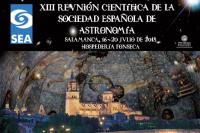
Isdefe, which has considerable experience and know-how in the field of astrophysics and space sciences, took part yet again this year in the congress organised by the Spanish Astronomical Society and which hosted its 13th scientific gathering.

The event, held in Salamanca from 16 to 20 July, brought together most of Spain’s astrophysics community and featured more than 400 professional astronomers.
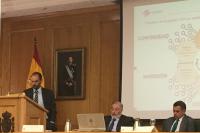
The course, organised by CESEDEN along with the Universidad Politécnica de Madrid, was held from 16 to 18 July and featured Isdefe and public and private agencies involved with defence technology. One of the goals of the event was to introduce and discuss the opportunities derived from the European Union’s involvement in defence.

On Thursday, 10 July, as part of the summer courses programme at the Universidad de León, a workshop was held on “Spanish contributions to the programme to monitor and track space debris”. This workshop was opened by the Rector, Mr Juan Francisco García Marín. During the course, speakers from the Ministry of Defence and the Armed Forces, the CDTI, the Universidad de León and representatives from leading companies in the sector considered the various challenges stemming the threats posed to satellites by objects in near-Earth orbits (such as space debris).

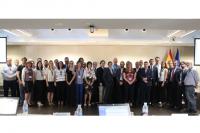
Isdefe is hosting the initial meeting and launch of the European COPKIT Project, a new intelligence ecosystem to fight against terrorism and organised crime.

The primary purpose of the COPKIT Project, led by Isdefe and co-financed with EU funds from the H2020 initiative, is to create an intelligence and knowledge ecosystem for law enforcement agencies (LEA) in an effort to prevent, investigate and mitigate the use of new information and communication technologies by organised crime and terrorist groups by developing an early alert/early action system.

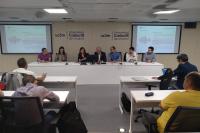
As part of the Space Horizon programme of the Horizons Network, the Carlos III University (UC3M) in Madrid and Isdefe organised a roundtable to go over the technologies that are needed to track and monitor space junk.

On 20 June, at the conference room in the Madrid-Puerta de Toledo campus of the UC3M, representatives from industry companies, along with experts from the UC3M and representatives from the General Directorate of Armaments and Materiel, SatCen (EU Satellite Centre) and Isdefe, sat down to explain how these tracking systems work, as well as the technological