





Cyberintelligence Workshops held at Isdefe
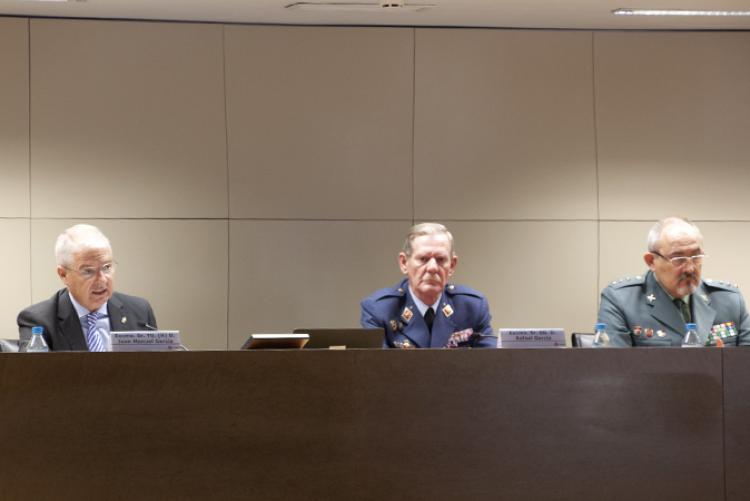
Isdefe’s headquarters welcomed the Cyberintelligence Workshops, organised by the University Research Institute for Homeland Security (IUSI) and the Civil Guard’s Information Office.
The workshops were opened by Lieutenant General Fernando Santafé, of the Civil Guard’s Operations Command, Ms Fani Castro, Director of IUISI, Division General Pablo Salas, Commander of the Civil Guard’s Information Office, and Mr José Manuel Hesse, Isdefe’s Head of Operations.
On 16 and 17 October, 28 expert speakers from the Civil Guard, Armed Forces, the National Cryptology Centre of the National Intelligence Centre, the National Centre for the Protection of Critical Infrastructure, the National Cybersecurity Institute, academia, Europol, research analysts from the United Kingdom and Germany, and from Isdefe shared their knowledge and experiences in this area.
The workshops addressed the various intelligence needs of the physical, logical and social layers into which cyberspace is structured, as well as the different tools and procedures needed at the strategic, technical, tactical and operational levels in order to protect this new cyberspace frontier.
With a total of 28 speakers, the subjects discussed included cyberintelligence and its impact on national defence, the protection of critical infrastructure and the need for cross-border cooperation. One success story was presented involving the “BARRAD Operation as an example of shared cyberintelligence in the fight against Jihadist terrorism”.
In addition to the CSIRT.es project, a platform consisting of CSIRT/CERT security incident response teams to protect Spain’s cyberspace by exchanging cybersecurity information and executing a fast and coordinated response to any incident, the workshops also considered innovation and cooperation projects, like DARPA’s (the United Stated Defense Advanced Research Projects Agency) MEMEX project and EUROPOL’s SIRIUS platform to facilitate cyberterrorism investigations.
Representatives from academia presented the latest advances in cyberintelligence to identify, classify and predict threat and risk patterns. These advances use artificial intelligence techniques that rely on machine learning and knowledge inference algorithms.
Isdefe experts Juan Carlos Iravedra and Raquél Pastor, from the Public Safety Department of Isdefe’s Defence and Security Office, presented “the EU’s approach as seen through its framework programmes, specifically Horizon 2020” and discussed success stories like COPKIT+ePOOLICE +MEDEA. Open-source knowledge plays a key role in all of these projects as part of the early warning and response systems to security threats.
The closing presentation, “Cyberintelligence as a key instrument in the defence of democratic states”, was given by Mr Rafael García, Division General (Air Force), Head of the Joint Cyberdefence Command (MCCD), who spoke about cyberintelligence and cyberspace as a new and unique battleground.
Closing the event were Mr Luis F Hernández, Coronel, Head of the Information Office’s Technical Department and authority in the Civil Guard General Directorate in the areas of cybersecurity, cyberterrorism and cyberdefence, and Lieutenant General (Ret.) Juan Manuel
Isdefe’s headquarters welcomed the Cyberintelligence Workshops, organised by the University Research Institute for Homeland Security (IUSI) and the Civil Guard’s Information Office.
The workshops were opened by Lieutenant General Fernando Santafé, of the Civil Guard’s Operations Command, Ms Fani Castro, Director of IUISI, Division General Pablo Salas, Commander of the Civil Guard’s Information Office, and Mr José Manuel Hesse, Isdefe’s Head of Operations.
On 16 and 17 October, 28 expert speakers from the Civil Guard, Armed Forces, the National Cryptology Centre of the National Intelligence Centre, the National Centre for the Protection of Critical Infrastructure, the National Cybersecurity Institute, academia, Europol, research analysts from the United Kingdom and Germany, and from Isdefe shared their knowledge and experiences in this area.
The workshops addressed the various intelligence needs of the physical, logical and social layers into which cyberspace is structured, as well as the different tools and procedures needed at the strategic, technical, tactical and operational levels in order to protect this new cyberspace frontier.
With a total of 28 speakers, the subjects discussed included cyberintelligence and its impact on national defence, the protection of critical infrastructure and the need for cross-border cooperation. One success story was presented involving the “BARRAD Operation as an example of shared cyberintelligence in the fight against Jihadist terrorism”.
In addition to the CSIRT.es project, a platform consisting of CSIRT/CERT security incident response teams to protect Spain’s cyberspace by exchanging cybersecurity information and executing a fast and coordinated response to any incident, the workshops also considered innovation and cooperation projects, like DARPA’s (the United Stated Defense Advanced Research Projects Agency) MEMEX project and EUROPOL’s SIRIUS platform to facilitate cyberterrorism investigations.
Representatives from academia presented the latest advances in cyberintelligence to identify, classify and predict threat and risk patterns. These advances use artificial intelligence techniques that rely on machine learning and knowledge inference algorithms.
Isdefe experts Juan Carlos Iravedra and Raquél Pastor, from the Public Safety Department of Isdefe’s Defence and Security Office, presented “the EU’s approach as seen through its framework programmes, specifically Horizon 2020” and discussed success stories like COPKIT+ePOOLICE +MEDEA. Open-source knowledge plays a key role in all of these projects as part of the early warning and response systems to security threats.
The closing presentation, “Cyberintelligence as a key instrument in the defence of democratic states”, was given by Mr Rafael García, Division General (Air Force), Head of the Joint Cyberdefence Command (MCCD), who spoke about cyberintelligence and cyberspace as a new and unique battleground.
Closing the event were Mr Luis F Hernández, Coronel, Head of the Information Office’s Technical Department and authority in the Civil Guard General Directorate in the areas of cybersecurity, cyberterrorism and cyberdefence, and Lieutenant General (Ret.) Juan Manuel